How to Hire Stylists Who Actually Stay and Sell (Before Your Next Busy Season Hits)
Aug 31, 2026
Last year, the data behind the retail labor market told a strange story. Between January and May, the US saw nearly 76,000 retail job cuts. At the same time, retail sales hadn't moved in seven straight quarters. Stores weren't cutting people because customers stopped showing up, automation had quietly taken over parts of the process that used to require a person.
So there should have been no shortage of experienced retail talent looking for work. And yet, when employers were surveyed, 70% said they were still struggling to fill their open positions with people they actually wanted to hire.
That's an indicator of a process problem, and bridal shops feel it harder than almost anyone, because this job asks for something specific. Weekend availability without resentment. Comfort with pay that moves based on what you sell. The composure to guide a bride through the biggest purchase of her life while her mother, her future mother in law, and four opinionated bridesmaids are all weighing in at once. Most hiring processes were never built to screen for any of that.
Why Good Candidates Walk Away From Bridal Roles
Four objections come up constantly when bridal shops try to hire, and each one has a real fix.
The first is pay. If a candidate is comparing a flat hourly wage against driving for a rideshare app, hourly alone will lose every time. The fix isn't guessing at a higher number, it's knowing your margins well enough to know what you can actually afford to pay in bonus or commission on top of a solid base.
The second is scheduling. A lot of candidates say they want flexibility, but what they're usually describing is control over their life, not random hours. A set schedule, the same three or four days every week, sells better than flexibility does, because it lets someone build real plans around it instead of waiting on a text.
The third is people fatigue. Some candidates are genuinely worn out from working with the public all day. Others left a remote job specifically because they missed people and just haven't found their way back yet. The fix is screening for which one you're actually talking to, not assuming everyone wants the same thing.
The fourth is the stepping stone mindset. I heard about a candidate interview once where the applicant was still in cosmetology school, thrilled about the role, clearly personable. The obvious follow up question was how long she had left in school. A few months. And after that? She was planning to become a nail tech. She wasn't being difficult, she just had never been shown a reason to see this as a career instead of a placeholder. That's on us to fix before it's ever on her.
Build the Career Ladder Before You Post the Job
The single biggest thing that turns a job into a career in a candidate's mind is a real compensation chart, one that shows a stylist exactly what it looks like to grow inside your store instead of leaving it.
A workable structure looks something like this: support and steam roles at the base, then a stylist role with a solid hourly wage plus a bonus tied to personal sales, then a shift leader role for someone taking on extra responsibility, then a department manager role with a bonus tied to their team's KPIs, and finally a general manager role compensated on a percentage of store profit rather than a flat rate, so growth stays tied to actual profitability instead of just top line sales.
Where to Actually Find These People
Not all job boards perform the same. Generic professional networking sites tend to underperform for retail floor roles specifically, while general job sites and retail-specific job boards tend to bring in candidates who already understand what a weekend, commission-driven, people-facing job actually feels like.
It's also worth paying attention to where trained retail talent already exists. A stylist who came from a brand known for rigorous sales training walks in the door already fluent in a level of selling skill that would otherwise take months to build from scratch. Keeping a job listing active year round, rather than only posting when you're desperate, costs very little and means you're never starting your search from zero when someone great happens to be looking.
The Three Green Flags Before Anyone Gets an Interview
Before a resume even gets a phone call, three things are worth screening for.
- Has this person worked weekends before, not just been willing to, but actually done it.
- Have they ever had income that fluctuated based on performance, whether that's tips, commission, or straight sales, so a bridal bonus structure isn't their first experience with variable pay.
- And do they have some background working with people, in any form of sales or service, so the role isn't their first time reading a customer.
Why Even a Great Process Still Misses People
Every owner I know has had the experience of hiring someone who did everything right through the entire process and still didn't work out six months later. It's not a failure of effort. It's the limit of what an interview alone can tell you, because a great interview and a great salesperson are not always the same person.
That's where a personality or behavioral assessment earns its cost. Predictive Index is detailed and useful, but expensive enough that it usually makes more sense for a manager hire than a floor stylist. The Enneagram is free and interesting, but has too many outliers to rely on by itself. Working Genius, for a small fee, tends to surface a clearer pattern for sales roles specifically, with certain working styles showing up again and again in high closers and others showing up more often in people who burn out under sales pressure. None of these are perfect, and there will always be outliers who defy the pattern. But used as one more data point before an offer, they catch things a conversation alone will miss.
This Is Exactly Why We Built the Bridal Success Index
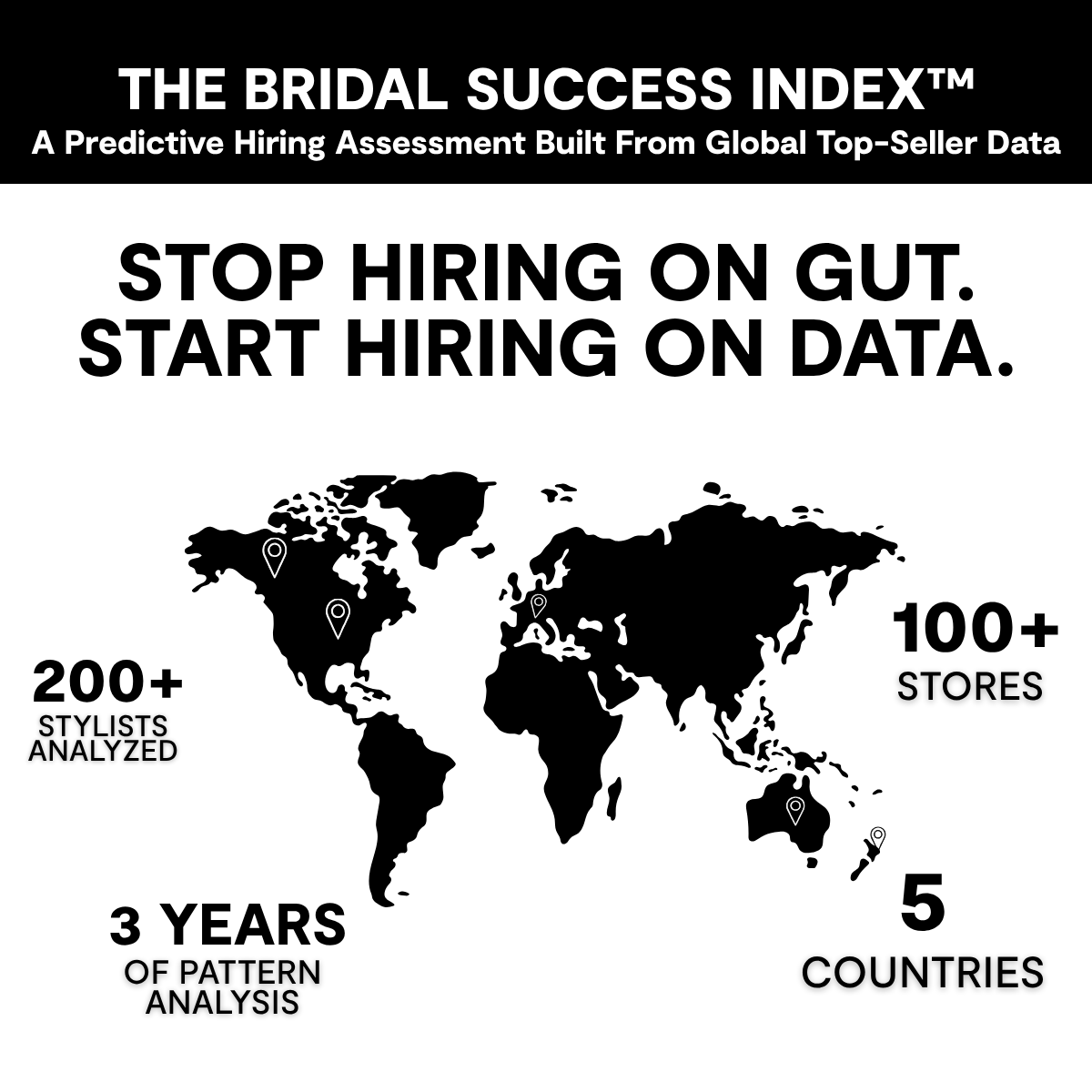
Bridal sales isn't traditional retail. It's emotional, time sensitive, high pressure, and commission driven, and yet most owners are still making hiring decisions based on personality, a resume, a feeling that someone seems like a fit, or plain hope. A poor hire doesn't just cost payroll. It costs missed revenue, team morale, reputation with your brides, and your own leadership energy. There has never been a predictive hiring tool built specifically for this industry, until now.
In partnership with a third-party research firm, we analyzed behavioral assessment data from more than 200 top-performing bridal stylists across five countries and identified the repeatable performance traits shared by the highest sellers, regardless of geography, market size, or store volume. The Bridal Success Index isn't a personality quiz, it's a performance predictor built from that data.
It measures four things.
Momentum and closing: a candidate's natural ability to guide a bride toward clarity and bring an appointment to a decision without pressure or awkwardness.
Pressure response: how someone actually performs when family opinions intensify, budgets tighten, or uncertainty creeps into the room.
Emotional reading: the situational awareness to pick up on unspoken cues, navigate family dynamics, and build trust quickly.
Ownership and drive: the intrinsic motivation and personal accountability that separates someone who shows up from someone who actually performs.
It's built to be the last step before you make an offer, not the first. A candidate receives a secure, single-use link, completes the evaluation privately, and the results come directly to you, not to them, so you're making the final call with real data behind it instead of a gut feeling you're hoping holds up.
You are not asking too much by wanting someone who shows up, sells with confidence, and stays. The right people are out there. What most shops are missing isn't candidates, it's a way to actually see which ones are the real fit before the offer goes out, not six months after it does.